
Moxibustion and Acupuncture for Breech Babies in Drouin and Traralgon
Been told your baby is breech? You may have more options than you think, and timing matters.
At Cocoon Acupuncture, our AHPRA-registered Chinese medicine practitioners offer moxibustion and acupuncture for breech presentation, working alongside the care you're already receiving from your midwife, GP or obstetrician. Our clinics are in Drouin and Traralgon, close to Warragul, Moe and Morwell.
What does it mean if my baby is breech?
A baby is breech when they are lying bottom-first or feet-first in the uterus, instead of head-down. Being breech is very common earlier in pregnancy. Most babies turn head-down on their own by around 36 weeks, and only a small percentage are still breech at term.
If your baby is still breech late in pregnancy, your midwife or obstetrician will talk with you about your options. These may include:
Waiting to see if your baby turns on their own
External cephalic version (ECV), where an obstetrician gently turns the baby from the outside of your belly
Planned caesarean birth
Planned vaginal breech birth, in some hospitals and circumstances
Many people also look into complementary approaches, such as moxibustion, to use alongside their maternity care.
What is moxibustion?
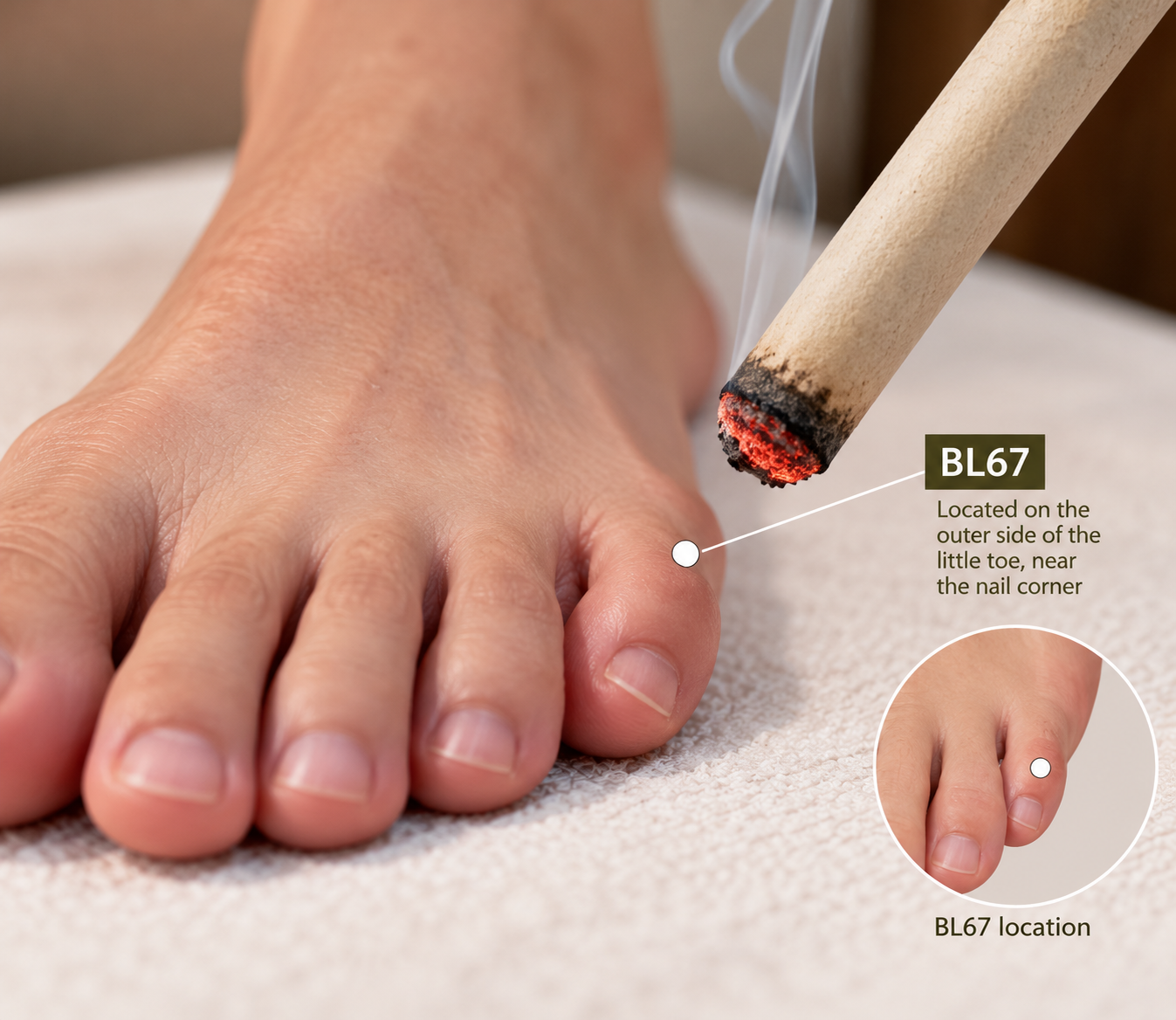
Moxibustion is a traditional Chinese medicine technique that uses gentle heat from a smouldering stick of dried mugwort (moxa). For breech presentation, the moxa stick is held near, but not touching, an acupuncture point on the outer corner of each little toe, called Zhiyin (BL67).The treatment is painless. Most people feel a pleasant warmth, and many notice their baby becoming more active during or after treatment.
How is acupuncture used for breech presentation?
Acupuncture is often used together with moxibustion as part of breech treatment. Fine, sterile, single-use needles are placed at selected points, which may include Zhiyin (BL67) on the little toe and other points chosen to help you relax and ease tension through the lower back, hips and pelvis. Some of the clinical trials on breech presentation looked at acupuncture and moxibustion used together. Our practitioners are trained in pregnancy care and adjust treatment for pregnancy, avoiding points that aren't appropriate and using comfortable, supported positions. Acupuncture during pregnancy is generally well tolerated, and many people find their sessions a calming time to rest and connect with their baby.
When should I start?
Timing is important. Moxibustion for breech is most commonly started between 32 and 35 weeks of pregnancy, while there is still room for the baby to move. It can sometimes be used later, but the earlier window is generally preferred.
If your midwife or obstetrician has told you your baby is breech, it's best to contact us as soon as possible rather than waiting.
What does treatment at Cocoon involve?
A consultation first. We review your pregnancy, your ultrasound or clinical findings confirming breech presentation, and any risk factors, to check that moxibustion is suitable for you.
In-clinic treatment. Your practitioner performs acupuncture and moxibustion and may also use electro-acupuncture as part of your session.
Home treatment. We teach you and your partner or support person how to do moxibustion safely at home, usually once or twice a day for around 7 to 10 days. You'll take home moxa sticks and written instructions.
Follow-up. We'll check in on your progress and how home treatment is going.
What does the research say?
Moxibustion for breech presentation has been studied in a number of clinical trials, and these have been assessed in a Cochrane systematic review. The review found some evidence that moxibustion, particularly when combined with acupuncture or postural techniques, may reduce the number of babies who are still breech at birth and the need for ECV. The overall quality of the evidence is low, and results vary. We'll talk you through realistic expectations at your first appointment.
Working alongside your midwife or obstetrician
Moxibustion is used alongside your maternity care, not instead of it. Please keep your midwife, GP or obstetrician informed, and attend all your scheduled appointments. Moxibustion can be used before a planned ECV, and your maternity team will confirm your baby's position with a check or ultrasound.
Is moxibustion safe for me?
Moxibustion is generally considered low risk when used appropriately, but it isn't suitable for everyone. Before treatment, we'll check whether any of the following apply to you. Moxibustion is usually not recommended if you have:
Placenta praevia (a low-lying placenta) or a history of bleeding in this pregnancy
High blood pressure or pre-eclampsia
Low amniotic fluid, or your waters have broken
Concerns about your baby's growth or wellbeing
A previous caesarean or other uterine surgery, unless cleared by your obstetrician
Any other condition your maternity team has advised needs special care
If you're unsure, ask your midwife or obstetrician before booking, or call us to talk it through.
Contact your maternity unit straight away if you notice:
Vaginal bleeding
Fluid leaking from the vagina
Regular contractions or abdominal pain
A change in your baby's usual pattern of movements, including fewer movements
Stop home moxibustion and seek advice if any of these occur. In an emergency, call 000.
Serving West and Central Gippsland
Cocoon Acupuncture Drouin
2/2 Sinclair Street Drouin
Convenient for patients from Drouin, Warragul, Longwarry, Buln Buln and the surrounding Baw Baw area.
Cocoon Acupuncture Traralgon
134 Princes Street Traralgon
Convenient for patients from Traralgon, Morwell, Moe, Churchill and the wider Latrobe Valley.
Frequently asked questions
Can moxibustion turn a breech baby? Some research suggests moxibustion may help reduce the number of babies who are still breech at birth, particularly when combined with acupuncture or postural techniques. It doesn't work for everyone. We'll talk through what to expect at your first appointment.
How many weeks pregnant should I be? Moxibustion for breech is most commonly started between 32 and 35 weeks. Contact us as soon as you know your baby is breech, so there's time to complete a course of treatment.
Does moxibustion hurt? No. The moxa stick doesn't touch your skin. Most people feel a gentle, pleasant warmth on their little toes.
Can I do moxibustion at home? Yes, once you've had an assessment and been shown how. We teach you and a support person how to do it safely and give you the moxa sticks and written instructions to take home.
Does moxibustion smell? Yes, moxa produces a distinctive earthy smoke. If you're doing it at home, use a well-ventilated room or an outdoor area, and keep it away from smoke alarms.
Is moxibustion an alternative to ECV? Moxibustion is a complementary treatment, not a replacement for your maternity care. Some people try moxibustion first and still go on to have an ECV if their baby hasn't turned. Your midwife or obstetrician can advise you on ECV.
Do I need a referral? No, you don't need a referral. We do ask that your breech presentation has been confirmed by your midwife, doctor or an ultrasound, and that your maternity team knows you're having moxibustion.
Can I claim on private health insurance? Acupuncture is covered by many private health funds under extras cover. Rebates depend on your fund and level of cover, so check with your insurer. We have HICAPS on site so you can claim on the spot.
If you've been told your baby is breech, book a consultation at our Drouin or Traralgon clinic as early as you can.
Individual results vary. Moxibustion is a complementary treatment and does not replace care from your midwife, GP or obstetrician. Our practitioners are registered with the Chinese Medicine Board of Australia through AHPRA.
References
Coyle ME, Smith CA, Peat B. Cephalic version by moxibustion for breech presentation. Cochrane Database of Systematic Reviews. 2023. doi:10.1002/14651858.CD003928.pub4. https://cochranelibrary.com/cdsr/doi/10.1002/14651858.CD003928.pub4/information
Cardini F, Weixin H. Moxibustion for correction of breech presentation: a randomized controlled trial. JAMA. 1998;280(18):1580–1584. doi:10.1001/jama.280.18.1580. https://pubmed.ncbi.nlm.nih.gov/9820259/
Neri I, Airola G, Contu G, Allais G, Facchinetti F, Benedetto C. Acupuncture plus moxibustion to resolve breech presentation: a randomized controlled study. Journal of Maternal-Fetal & Neonatal Medicine. 2004. https://iris.unimore.it/handle/11380/451547
Correction of breech presentation with moxibustion and acupuncture: a systematic review and meta-analysis. https://www.ncbi.nlm.nih.gov/pmc/articles/PMC8224784/